From Cold List to Booked Call Without a Human Touching It: How AI Lead Generation Is Changing Business Revenue
AI agents are now handling the entire journey from cold prospect to booked sales call, removing human bottlenecks and driving consistent revenue for businesses.

The businesses winning right now are not the ones with the biggest sales teams. They are the ones who have built systems that qualify, nurture and convert prospects while their team sleeps.The Agency
Find the gaps leaking the most revenue
Show me my revenue leak Your annual leak in pounds, in 30 seconds. Free.The entire journey from a cold name on a list to a confirmed appointment in your calendar can now happen without a single human being involved at any stage. Businesses using AI agents for lead generation are reporting fuller pipelines, shorter sales cycles and sales teams that spend their time closing rather than prospecting. The question is no longer whether this is possible. The question is why more businesses are not doing it yet.
What We Mean by Cold List to Booked Call
Let us be precise about what this process actually involves, because the phrase gets used loosely and it is worth understanding the full scope of what AI agents are now capable of handling.
A cold list is a set of contacts who have never heard from your business. They have not opted in, they have not raised their hand, and they have no prior relationship with you. Converting even a small percentage of that list into booked calls has traditionally required a dedicated outbound team, a significant amount of manual effort, and a great deal of patience with rejection.
The journey from that cold contact to a booked call involves several distinct stages. First, there is the initial outreach, which must be personalised enough to earn a reply. Then there is the follow-up sequence, which most sales reps handle inconsistently because it is repetitive and demoralising. Then there is the handling of replies, including objections, questions and the occasional interested prospect who needs a nudge. Then there is the qualification conversation, where you establish whether this person is actually a good fit. And finally there is the booking itself, getting a time confirmed and a calendar invite accepted.
AI agents can now handle every single one of those stages. Not approximately. Not partially. Every stage, including the back-and-forth replies, the objection responses and the calendar booking, without any human involvement until the prospect appears on a call ready to buy.
Why Human-Led Outbound Has Always Been Inconsistent
Before we explain how AI agents solve this, it is worth understanding why human-led outbound has always been such an unreliable revenue channel for most businesses.
The core problem is that outbound prospecting is psychologically draining work. It involves contacting people who did not ask to be contacted, receiving a great deal of silence or rejection, and maintaining enthusiasm and consistency across dozens or hundreds of touchpoints every day. Even the best sales professionals struggle to maintain quality outreach at volume over sustained periods.
The result is that most outbound programmes are inconsistent. Follow-ups get skipped. Personalisation gets dropped when volume increases. Reply handling slows down because the rep is juggling too many conversations at once. And the moment a rep gets busy with existing clients or closing deals, the top of the funnel dries up entirely.
This inconsistency is expensive. Businesses invest heavily in building contact lists, in tools, in training and in salaries, and then get unpredictable results because the human element introduces variability that compounds at every stage of the process. AI agents remove that variability entirely.
How AI Agents Handle the Entire Outreach Sequence
An AI lead generation agent operates on a fundamentally different model to both a human sales rep and traditional email automation. It is not simply sending pre-written emails on a timer. It is reading and understanding replies, making decisions based on what those replies contain, and responding in a way that is appropriate to the specific conversation.
When a prospect replies with a question, the AI answers it. When a prospect raises an objection, the AI addresses it using the business's own language, positioning and proof points. When a prospect expresses interest but says the timing is not right, the AI acknowledges that and schedules a follow-up for the appropriate moment. When a prospect says they are ready to talk, the AI books the call.
This happens across every conversation in the pipeline simultaneously. An AI agent does not get tired, does not lose enthusiasm on a Friday afternoon, and does not forget to follow up with that interested prospect who went quiet three days ago. The system holds the thread of every conversation without dropping a single one.
The personalisation is also more sophisticated than most people expect. AI agents can research prospects before reaching out, incorporating relevant context about their business, their role, their recent activity or their industry into the initial message. This is not mail-merge personalisation where you insert a first name and a company name. It is genuine contextual relevance that makes the outreach feel considered rather than automated.
The Revenue Impact of Removing the Human Bottleneck
The commercial logic here is straightforward, and it is the reason businesses that adopt AI lead generation tend to see meaningful revenue impact relatively quickly.
When human sales reps are doing outbound, their capacity is finite. There is a ceiling on how many contacts they can reach, how many follow-ups they can manage and how many conversations they can hold at once. That ceiling limits the number of booked calls that can come in, which limits the number of deals that can close, which limits revenue.
AI agents do not have that ceiling. A single AI agent can manage outreach to a large number of contacts simultaneously, follow up consistently with all of them, handle all of the replies in real time and book calls continuously. The pipeline does not slow down because the agent had a difficult day. It does not empty because the agent got pulled onto a client project. It runs constantly, producing booked calls at a rate that a human team simply cannot match.
This changes the economics of customer acquisition in a significant way. Businesses that previously could only afford to run small outbound programmes because of headcount costs can now run much larger programmes at a fraction of the cost per booked call. And because the quality of the outreach is consistent rather than variable, the conversion rates through the funnel tend to be more predictable as well.
If you want to understand what this could look like for your specific business and offer, our team has built a process for mapping this out clearly. You can start that conversation through our AI lead generation strategy session and get a clear picture of what a system like this could produce for your pipeline.
What Needs to Be in Place Before You Deploy
AI agents are powerful, but they are not magic. There are things that need to be in place before you deploy one, and businesses that skip these steps tend to get disappointing results.
The most important is a clear and compelling offer. An AI agent is an amplifier. If your offer is weak or unclear, the agent will simply deliver that weak offer to more people more consistently. Before deploying AI outreach, you need to know precisely who you are targeting, what problem you solve for them, why your solution is better than the alternatives, and what you are asking them to do next. If that clarity does not exist, fix it before you start.
The second requirement is a quality contact list. AI outreach to a poorly segmented or outdated list will produce poor results regardless of how sophisticated the agent is. The list needs to contain the right people, with accurate contact details, and ideally some form of segmentation that allows the AI to tailor its approach based on the specific profile of each prospect.
The third requirement is proper training of the agent on your business context. The AI needs to understand your offer, your typical objections, your tone of voice, your proof points and your booking process. This is not a long or technically complex process, but it is an important one. A well-trained agent sounds like an expert on your business. A poorly trained agent sounds generic and unconvincing.
Integrating AI Agents With Your Existing Sales Process
One concern we hear regularly from businesses considering this approach is that it will disrupt their existing sales process or make their sales team redundant. Neither of those things tends to be true in practice.
AI agents are most effective when they handle the part of the sales process that human beings are least well suited to, which is the high-volume, repetitive, rejection-heavy work of cold outreach and early-stage nurturing. When the agent has done that work and booked a call, the human sales team takes over for the part they are best at, which is building rapport, understanding nuance, handling complex objections and closing deals.
The effect for most businesses is that their sales team spends more of their time doing the work they were hired to do and less of their time doing the work that could be automated. Morale tends to improve. Performance tends to improve. And the pipeline tends to be fuller and more consistent than it was before.
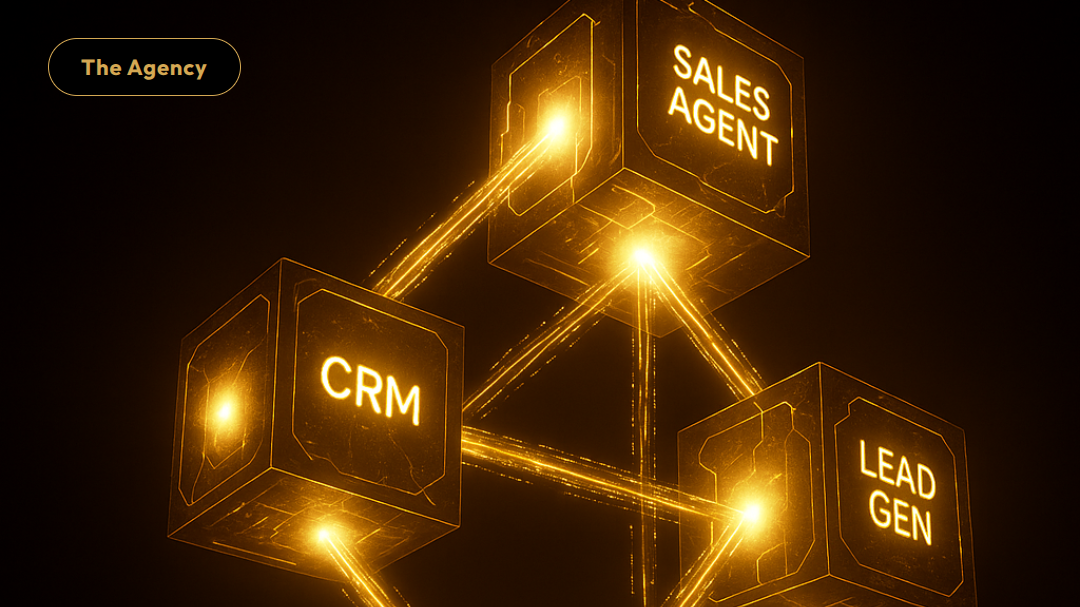
Integrating an AI agent into an existing sales process also does not require replacing your current tools. Most AI lead generation systems can connect to the calendar tools, CRM platforms and communication channels you already use, so the booked call appears in the right place and the prospect record is updated without anyone having to do it manually.
What the Future of AI Lead Generation Looks Like
We are at an early stage of what AI agents will eventually be capable of in the context of lead generation and sales. The systems that exist today are already producing results that would have seemed implausible a few years ago. But the trajectory of development in this space suggests that the gap between what AI can do and what humans can do in outbound sales will continue to close rapidly.
The businesses that are building these capabilities now are not just solving a near-term pipeline problem. They are building an infrastructure advantage that will compound over time. Every conversation the agent handles produces data. Every reply it receives, every objection it handles, every booking it makes contributes to a body of knowledge about what works for that business in that market. That knowledge can be used to make the system more effective continuously.
Businesses that wait until AI lead generation becomes mainstream before adopting it will find themselves building from scratch at the same time as their competitors are running mature, optimised systems. The advantage of moving now is not just the booked calls you get this month. It is the head start you build in understanding how to use these tools effectively in your market, with your offer, to your audience.
The cold list to booked call journey no longer requires a human to touch it. The businesses that accept that fact and build accordingly are the ones that will grow their revenue most efficiently in the years ahead.
Find the gaps leaking the most revenue
Show me my revenue leak Your annual leak in pounds, in 30 seconds. Free.Frequently asked questions
Can AI really book sales calls without any human involvement?
Yes. AI agents can handle the entire outreach sequence, from initial contact through follow-up and objection handling, to booking a call directly into a calendar. The human sales team only steps in once a qualified prospect has already committed to a conversation. This removes the most time-consuming and inconsistent part of the lead generation process.
How does AI lead generation differ from traditional email automation?
Traditional email automation sends pre-written sequences on a fixed timer regardless of how a prospect behaves. AI lead generation responds dynamically to replies, adjusts messaging based on engagement signals, handles objections in real time and personalises outreach at a level that static sequences simply cannot match. The result is a conversation that feels human even though no human is involved.
Is AI lead generation suitable for small businesses or only large enterprises?
AI lead generation is particularly well suited to small and medium businesses because it allows a lean team to compete with far larger organisations. A business with two or three people in sales can run the same volume and quality of outreach as a team of twenty, without the overhead. The technology levels the playing field in a meaningful way.
What types of businesses benefit most from AI agents in lead generation?
Any business that sells a product or service requiring a conversation before purchase tends to see strong results. This includes professional services, SaaS companies, agencies, consultancies and B2B product businesses. If your sales process currently involves a discovery call, a demo or a proposal, AI agents can handle everything up to that point automatically.
How long does it take to see results from an AI lead generation system?
Most businesses begin seeing booked calls within the first few weeks of deploying a properly configured AI lead generation system. The timeline depends on the quality of the contact list, the strength of the offer and how well the AI has been trained on the business context. Unlike hiring and training a new sales rep, the ramp-up period is measured in days rather than months.
Will prospects know they are talking to an AI during outreach?
This depends entirely on how the system is configured and what the business wants. Some businesses choose full transparency and position their AI outreach as such. Others use AI to draft and personalise messages that are sent under a team member's name, with the AI handling replies autonomously. Both approaches are used successfully, and the right choice depends on the brand, the audience and the nature of the sale.