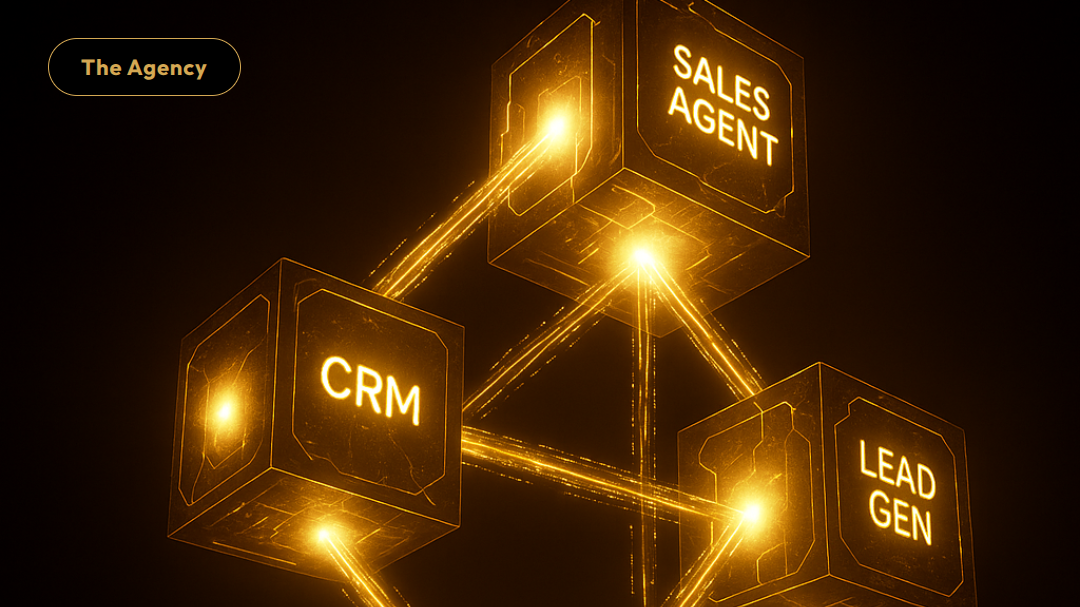
How to Build a Sales Pipeline That Runs While Your Team Sleeps Using AI Agents
AI agents are generating leads, qualifying prospects and booking meetings around the clock, so your sales team wakes up to a pipeline already full.

The businesses winning right now are not the ones working harder, they are the ones that have built systems smart enough to work without them. An AI-powered pipeline does not take weekends off, and neither should your lead generation.The Agency
Want to see what your business is leaving on the table?
I want a free AI audit Takes 30 seconds. 100% free. No call, no card.Businesses that build AI-powered sales pipelines are waking up to something that used to be reserved for companies with enormous sales teams: a full inbox of qualified leads, booked meetings and warm prospects, all generated overnight without anyone working late. The promise of a pipeline that runs while your team sleeps is no longer a futuristic concept. It is happening right now, and the businesses that have made the shift are growing their revenue in ways that purely human-driven sales operations simply cannot match.
The Problem With a Pipeline That Only Works When You Do
Most sales pipelines are built around human effort, and human effort has a hard ceiling. Your team can only send so many emails, make so many calls and follow up on so many leads before the day runs out. The moment everyone logs off, the pipeline stops. Prospects who visit your website at midnight, enquiries that come in over the weekend and leads who finally respond to a message at 7am on a Tuesday all sit untouched until someone gets to them, by which point the moment has often passed.
This is not a productivity problem. It is a structural one. If your pipeline depends entirely on people, it will always be limited by the hours those people are available. And in a world where buyers expect fast, relevant responses, a slow follow-up is often no follow-up at all.
The businesses that are pulling ahead are not necessarily working harder. They are working with systems that do not need to rest. AI agents have changed the fundamental shape of what a sales pipeline can look like, removing the ceiling on activity and making consistent, personalised outreach possible at any hour of the day or night.
What an AI Agent Actually Does Inside Your Pipeline
An AI agent is not simply an automated email sequence with a few merge fields. Modern AI agents can reason, adapt and respond based on context. Inside a sales pipeline, they can handle a remarkable range of tasks that used to require a human: researching prospects, crafting personalised outreach, responding to replies, asking qualifying questions, routing hot leads and booking meetings directly into your calendar.
The key difference between a basic automation and a true AI agent is the ability to handle variation. A standard automation breaks the moment something unexpected happens. An AI agent can read a response, understand the intent behind it and reply in a way that moves the conversation forward appropriately. If a prospect says they are interested but not right now, the agent notes it, schedules a follow-up and moves on. If someone asks a specific question about your service, the agent answers it. If a lead shows all the signs of being ready to buy, the agent escalates it immediately.
This is not science fiction. It is the kind of capability that is available to businesses of all sizes right now, and the gap between those using it and those that are not is growing every month.
Building the Foundation: Targeting, Data and Intent
No pipeline runs well without good inputs, and this is where many businesses stumble when they first try to automate their lead generation. They focus on the outreach mechanism before they have properly defined who they are reaching out to and why. The result is a high-volume, low-quality pipeline that burns contacts and delivers disappointing results.
The right approach starts with a clear, honest picture of your ideal customer. Not a vague description, but a specific profile built around the characteristics that actually predict a good outcome: the industries that convert, the company sizes that stay, the job titles that have buying authority, the triggers that indicate a prospect is in the market right now. Intent signals, things like recent hiring activity, new funding, technology changes or content engagement, are particularly valuable because they tell you not just who a prospect is but where they are in their own decision-making journey.
AI agents can be pointed at this defined audience and trusted to work through it systematically, personalising outreach based on what they know about each prospect and adjusting their approach based on the responses they receive. The targeting work you do upfront is what separates a pipeline that hums along productively from one that generates noise without revenue.
The Overnight Engine: How the Pipeline Keeps Moving
One of the most powerful things about an AI-driven pipeline is what happens in the hours your team is not working. Prospects in different time zones receive outreach at sensible local hours. Replies that come in at 2am get acknowledged and responded to within minutes. Follow-up sequences continue on schedule regardless of whether it is a bank holiday, a Friday afternoon or the middle of the night.
This consistency is, in practice, a significant competitive advantage. Most of your competitors are still relying on human SDRs or purely manual outreach. They are experiencing the same gaps, the same slow follow-ups, the same dropped threads that happen when people get busy. Your pipeline, running on AI agents, does not have those gaps.
The pipeline also compounds over time. Every interaction generates data. Which subject lines get opened, which messages get replies, which sequences convert, which qualification questions reveal the most useful information. A well-configured AI pipeline learns from this activity and improves. Over weeks and months, the targeting gets sharper, the messaging gets tighter and the quality of leads arriving in your sales team's hands keeps improving.
If you want to see what this kind of setup could look like for your specific business, explore a custom AI pipeline strategy built around your goals and your audience.
What Your Sales Team Does Differently When the Pipeline Runs Itself
Something important happens when your sales team is no longer responsible for generating their own pipeline. They stop spending the majority of their time on prospecting, research and follow-up admin, and they start spending it on the conversations that actually require a human: the nuanced discovery calls, the relationship-building, the negotiations and the closes.
This reallocation of human effort tends to have a significant effect on results. Sales people who spend their day on high-value conversations, rather than grinding through cold outreach, are sharper, more focused and more effective. They arrive at each call better prepared because the AI has already gathered information and provided context. They are not chasing cold leads because the warm ones are being served up to them.
The dynamic also changes the culture around pipeline anxiety. When your team knows that leads are being generated continuously, with or without their direct involvement, the pressure to constantly be doing more prospecting eases. They can focus on being excellent at selling, rather than on being excellent at finding people to sell to. Those are genuinely different skills, and most great salespeople would rather be doing the former.
Common Mistakes That Stall the AI Pipeline Before It Starts
For all its power, an AI-driven sales pipeline is not plug-and-play. There are several mistakes that repeatedly trip businesses up when they first attempt to build one, and understanding them upfront saves a great deal of time and frustration.
The most common is treating the AI as a replacement for strategy rather than an executor of it. The AI can carry out your outreach with remarkable efficiency and consistency, but it cannot decide who you should be targeting, what your value proposition is or why someone should choose you over a competitor. Those answers have to come from you, and they need to be clear before you build anything.
A second common mistake is setting up the pipeline and leaving it entirely alone. Even the best AI systems benefit from regular review. Are the open rates where you want them? Are the conversations that are being generated actually leading to booked calls? Are the leads arriving in your CRM matching your ideal customer profile? Checking in regularly, adjusting the targeting, refreshing the messaging and tightening the qualification criteria is how a good pipeline becomes a great one.
Finally, many businesses underestimate the importance of the handoff between the AI and the human sales team. The moment a lead is flagged as warm and ready for a conversation, the human experience needs to be excellent. A brilliant AI pipeline feeding into a poor sales experience is a wasted opportunity. The two ends of the process have to be designed to work together.
The Businesses Growing Fastest Are Not Waiting
The businesses that are seeing the strongest pipeline growth right now are not waiting for AI lead generation to become more mainstream, more affordable or more proven. They are building these systems today and benefiting from the compounding returns of an approach that gets better and more efficient over time.
There is a real first-mover advantage in markets where your competitors are still doing things manually. The prospect who receives a thoughtful, well-timed, personalised message from you at 11pm on a Sunday, because your AI agent has been monitoring their activity and identified a trigger, is a prospect your competitor does not know about yet.
Building a sales pipeline that runs while your team sleeps is not about replacing your people. It is about making sure that your business is working every single hour of the day, even when your people are not. The businesses that crack this are the ones that stop treating sales as something that only happens during office hours and start treating it as a continuous, always-on engine that grows their revenue without growing their headcount at the same rate. That is the shift worth making.
Want to see what your business is leaving on the table?
I want a free AI audit Takes 30 seconds. 100% free. No call, no card.Frequently asked questions
Can AI agents really generate sales leads without human involvement?
Yes. Modern AI agents can identify target prospects, send personalised outreach, follow up on replies and qualify leads based on your criteria, all without a human lifting a finger. The key is setting up the right workflows, triggers and qualification rules at the start. Once configured, the system runs continuously and hands off only the warmest, most sales-ready leads to your team.
What types of businesses benefit most from an AI-driven sales pipeline?
Any business that relies on consistent lead generation and has a defined target audience stands to benefit enormously. Service businesses, SaaS companies, agencies and B2B firms with longer sales cycles tend to see the strongest results because AI agents excel at nurturing prospects over time. That said, even smaller businesses with modest teams can use AI pipelines to punch well above their weight in terms of outreach volume and follow-up consistency.
How do AI agents qualify leads compared to a human sales development rep?
AI agents qualify leads by applying your exact criteria, things like company size, job title, industry, engagement behaviour and responses to specific questions, without any emotional bias or inconsistency. They do not have a bad day, they do not skip steps and they do not forget to follow up. The result is a more consistent qualification process, though human judgement remains valuable for complex, high-value conversations once a lead has been properly warmed.
Will an AI-powered pipeline feel impersonal to prospects?
Not if it is built properly. The most effective AI pipelines use dynamic personalisation, pulling in details about the prospect's company, role and recent activity to make every message feel relevant and considered. The goal is not to flood inboxes with generic blasts but to deliver the right message to the right person at the right moment. Done well, prospects often cannot tell the difference, and in some cases the AI outreach is more timely and relevant than what a busy human rep would have sent.
How long does it take to see results from an AI sales pipeline?
Most businesses begin seeing meaningful pipeline activity within the first few weeks of a properly configured AI system going live. The early period is partly about learning, refining messaging, adjusting qualification criteria and improving targeting based on what the data shows. Over time, the pipeline compounds: the more interactions the system handles, the sharper the targeting and the stronger the results tend to become.
Do we need a large team or big budget to run AI-powered lead generation?
No, and that is one of the most exciting things about this approach. AI agents allow small and medium-sized businesses to run lead generation operations that would previously have required a full team of sales development reps. The upfront investment is in strategy and setup, but once the pipeline is live, the ongoing cost is a fraction of what human-only outreach would require. The leverage available to even a two or three person team is genuinely remarkable.