The Critical Difference Between an AI Chatbot and an AI Sales Agent Guide
AI chatbots answer questions. AI sales agents close deals. Here's why that distinction matters to your revenue.
A chatbot is a responder. An AI sales agent is a closer. Most businesses deploy the wrong tool because they don't understand the distinction.The Agency
Most businesses still treat their AI like a very expensive search engine. They deploy a chatbot, it answers customer questions, and then the conversation stops. That's not strategy. That's just outsourcing your FAQ section to the cloud.
The real distinction between an AI chatbot and an AI sales agent has nothing to do with processing power or the model running underneath. It has everything to do with what the AI is authorised to do, what information it can access, and most critically, what business outcome it's trying to achieve. A chatbot is a responder. An AI sales agent is a closer. And that difference rewires your entire customer journey.
This confusion costs businesses millions. Many executives believe they're deploying a sales agent when they've actually rolled out an expensive chatbot. The marketplace makes it worse by selling generic "AI solutions" that don't clarify which job they actually do. The result is predictable: disappointed stakeholders, wasted budget and a false conclusion that AI won't move the needle on revenue.
This guide cuts through that noise. We'll walk through what each tool actually does, why the distinction matters, and how to know which one your business needs.
What a Chatbot Actually Does
A chatbot is fundamentally passive. It waits for a customer to ask a question, then it retrieves and reshapes information to answer it. This is useful. A customer lands on your website at 11 PM on a Saturday and needs to know your refund policy. A chatbot gives them the answer in seconds instead of waiting for Monday morning. The customer feels heard. Your team avoids numerous repetitive emails.
But here's the architectural limit: the chatbot has no mandate to move the conversation towards a business outcome. It's not measuring whether the customer is actually interested in buying. It's not qualified to make a judgment call about pricing, discounts, custom arrangements or contract terms. It answers questions and that's the boundary of its job.
A chatbot also operates in read-only mode. It can access your knowledge base, your FAQ, your product documentation. It cannot access your CRM. It cannot check whether a customer is already in your pipeline. It cannot flag a lead for follow-up. It cannot trigger an email or schedule a call. Once the conversation ends, it's gone. Your sales team has no record of what was asked, no visibility into how close that prospect actually was to buying, no data to work from.
Think of a chatbot like a receptionist who is brilliant at answering phones but has no access to the filing system, no phone to dial, and no authority to make commitments. They can tell a caller what your business does and answer standard questions. But when the conversation ends, nothing happens. The caller doesn't get added to a list. No one follows up. No one knows they called. The company gained nothing from that interaction except a slight reduction in support load.
This is why chatbots are great for volume and terrible for revenue. They reduce friction on questions your team has already answered a hundred times. But they don't move leads down a sales pipeline. They don't qualify. They don't convert. They're a cost-saving tool dressed up as a sales tool.
What an AI Sales Agent Actually Does
An AI sales agent is active. It's not waiting for inbound questions. It's integrated into your CRM, your calendar, your email infrastructure. It has read-write access to the customer record. It knows the customer's history, their previous conversations, their objections, what stage of the buying journey they're in. It knows the pricing, the contract terms, the available options, the margins.
More critically, an AI sales agent is authorised to make value judgments. When a prospect expresses interest in your product, the agent doesn't just provide information. It qualifies the lead in real time, asks the follow-up questions that determine whether this is actually a fit, and if it is, the agent moves to close. It can negotiate on small terms. It can offer a limited-time incentive. It can schedule the next meeting. It can execute the steps that turn a prospect into a customer, without waiting for your team to manually intervene.
An AI sales agent also persists. Every conversation is recorded. Every question is tagged. Every objection is logged. When the conversation ends, your sales team has a complete record of what happened, what the prospect cares about, where they're hesitant, and what specific next step was agreed. That's not just data. That's a handoff. Your team knows exactly what to do when they take over.
The difference shows up immediately in practice. A prospect fills out a form on your website at 10 PM on a Tuesday. A chatbot might answer a few questions about your product. An AI sales agent would qualify the prospect, learn what problem they're trying to solve, understand their budget, uncover objections, offer a concrete next step and book the follow-up meeting, all without your team knowing a conversation ever happened. By the time your team arrives Wednesday morning, the lead is already in the pipeline with a complete history attached.
This is why AI sales agents are repeatable. Your team doesn't have to be present for every early conversation. The agent handles qualification, education, objection handling and initial commitment. Your human sellers focus on relationship building and closing the complex deals. The agent never sleeps. It never forgets a detail. It never gets tired of hearing the same objection for the hundredth time.
The Integration Difference
The technical difference is architectural. A chatbot is an isolated application. You embed it on your website or Slack channel. It's self-contained. It doesn't know anything about your business beyond what you put in its training data.
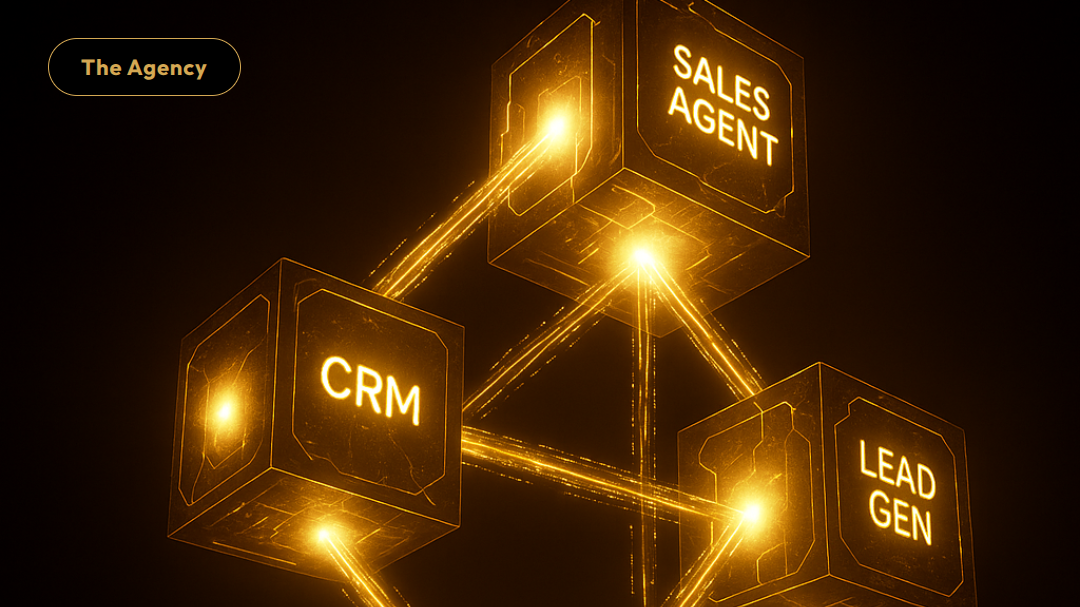
An AI sales agent is wired. It has API credentials to your CRM. It can read your contact records, your deal pipeline, your transaction history. It has access to your email provider so it can send follow-ups. It has calendar access so it can find free slots and suggest times. It knows your pricing engine, your discount rules, your inventory, your product catalogue. It's designed from the start to operate within your business infrastructure, not outside it.
This integration also creates accountability. When an AI sales agent makes a commitment to a customer, that commitment is recorded in your system automatically. Your team can see it. Your boss can audit it. You can measure it. A chatbot, by contrast, is a black box from your business perspective. You can't reliably track what was said or promised.
The integration requirement is why AI sales agents take longer to build and deploy. A chatbot lives in a sandboxed environment. An AI sales agent has to authenticate to multiple systems, handle sensitive customer data securely, and operate within strict guardrails that prevent it from making unauthorised commitments. But that complexity is the price of actually moving the needle on revenue.
For businesses that want to truly grow their sales engine, the integration is non-negotiable. It's the difference between having a tool that looks impressive and having a tool that actually works.
The Authority Question
Here's where most organisations get stuck. They build or purchase a chatbot and give it permission to answer questions. That's trivial to approve. The chatbot is read-only. It can't break anything.
But to build a real AI sales agent, you have to give it authority to act on your behalf. It needs to create new CRM records. It needs to tag leads. It needs to send emails. It needs to commit to delivery dates or pricing or contract terms. That terrifies most business owners. What if the agent makes a mistake? What if it says something we didn't approve?
This is a real concern, not paranoia. The answer is not to hobble the agent by withholding authority. The answer is to design the agent with clear guardrails. Define exactly which fields it can write to. Set the discount ceiling. Establish which email templates it can use. If the agent encounters a scenario it's not equipped to handle, it escalates to a human and waits for input. You maintain control. The agent operates within bounds.
In practice, this means building your agent with constraints baked in from day one. If your product's maximum discount is 15 per cent, the agent can't offer more. If your standard contract is 12 months, the agent can't commit to six. If a prospect's budget or use case falls outside what makes sense for your product, the agent recognises that and escalates the conversation to your team instead of forcing a bad fit.
The businesses that get this right treat the guardrails as a feature, not a limitation. The guardrails are what let them trust the agent to act autonomously. Without them, you have no choice but to keep the agent on a leash, which defeats the purpose of building it in the first place.
The Revenue Outcome
The practical difference shows up in your numbers. A chatbot reduces support load and improves customer satisfaction. Those are real benefits. But they show up as cost reduction, not revenue increase. You're spending less on customer service.
An AI sales agent changes your revenue curve. It qualifies more leads faster. It closes more deals because it's present during the critical moments when prospects need information and reassurance. It grows your selling without growing your team headcount. These agents work nights and weekends. They follow up when your team is offline. They handle initial conversations across time zones. They nurture leads that your team would never have time to touch. Over a year, this compounds into material revenue lift.
The best-case scenario is even clearer. If your AI sales agent is deployed in WhatsApp or Instagram DM (where customers already are), the conversion rate often climbs because you're meeting the prospect in their preferred channel at the moment they're ready to engage, not asking them to fill out a web form and wait for an email response.
The revenue multiplier comes from three dynamics that chatbots simply can't achieve. First, sales agents handle lead qualification automatically, which means your team only spends time on prospects who actually fit. Second, they work around the clock, which means you capture time zone advantages and late-night prospects that would slip through with a human-only team. Third, they persist every interaction in your CRM, which means your team has complete visibility into the prospect's state of mind and specific objections when they do take over the conversation. That handoff is everything.
Many businesses see a shift in their sales mix when they deploy an agent effectively. Deals close faster. The average deal size stays consistent or grows. Your team focuses on complex negotiations and relationship building instead of qualification calls. Your close rate often improves because the agent qualifies hard and only passes truly qualified leads to humans.
When to Choose Each
The starting point is honesty about what you're trying to achieve. If you want to reduce support tickets and improve response time, a chatbot is the right tool. It's faster to deploy, easier to control, and it does the job. Your FAQ section gets answers instantly. Your support team is freed up for complex issues. That's valuable.
If you want to grow your sales without proportionally growing your team, if you want to capture leads that currently slip through because your team is overloaded, if you want to compete with larger companies that already have round-the-clock sales support, then you need an AI sales agent. It's more complex to set up because it requires security thought and integration work. But it's the tool that changes the economics of your business.
The distinction matters because it changes everything about how you measure success, how much effort the project requires, and what outcome you should actually expect. Most businesses that claim they need an AI are really just asking for a chatbot and calling it something fancier. The ones that understand the difference, that get the integration right and give the agent real authority within guardrails, are the ones pulling material revenue lift.
How to Know Which You Actually Need
Start with these questions: Are you losing leads because your team can't respond fast enough? Are prospects dropping out because they can't book a call or get pricing information outside business hours? Is your sales team spending time on qualification calls that could be automated? Can you quantify how many leads slip through each month because no one picks up the phone?
If the answer to any of these is yes, you need a sales agent. If your bottleneck is support load and customer satisfaction scores on common questions, start with a chatbot and plan to upgrade later.
For businesses serious about using AI to transform their sales engine, the conversation typically begins with understanding your existing pipeline, your team's capacity constraints, and where the biggest revenue leaks are. That diagnosis determines whether you're building an agent, a chatbot or a combination of both.
Moving Forward
If you'd like to explore what an AI sales agent could mean for your specific business, we can walk through the options. The distinction between a chatbot and a sales agent determines not just the tool you build, but the revenue multiplier you actually achieve.
If you want to see the difference on your own pipeline, get a free AI audit and we will map where a real sales agent would lift your numbers.
Frequently asked questions
What's the main difference between an AI chatbot and an AI sales agent?
A chatbot answers questions from your knowledge base passively. An AI sales agent actively qualifies leads, handles objections, and closes deals using integration with your CRM, email and calendar.
Can an AI chatbot close sales?
Chatbots can provide information and guide prospects, but they lack CRM integration, authority to commit on pricing or terms, and the persistent records needed to handoff to your sales team.
Do AI sales agents work outside of business hours?
Yes. Sales agents operate continuously across time zones, handling conversations and follow-ups when your team is offline. This allows you to capture leads you would otherwise miss.
What security concerns should we have about giving an AI agent write access?
The solution is guardrails, not withholding authority. Define exactly which fields and actions the agent can perform, set discount ceilings, and let it escalate complex scenarios to humans.
Which generates more revenue: a chatbot or an AI sales agent?
Chatbots reduce support costs. Sales agents grow your revenue by qualifying more leads, closing more deals, and working continuously without requiring your team to grow proportionally.
How long does it take to deploy an AI sales agent?
Integration typically takes 4 to 8 weeks depending on your CRM complexity, security requirements and how much customisation you need. The setup is more complex than a chatbot but the revenue payoff justifies the effort.