B2B Outbound Prospecting: The Rule That Changed Everything
Personalisation at volume no longer means hand-written emails. It means AI-driven research that reads 15 sources per lead in 60 seconds. Here is what changed.
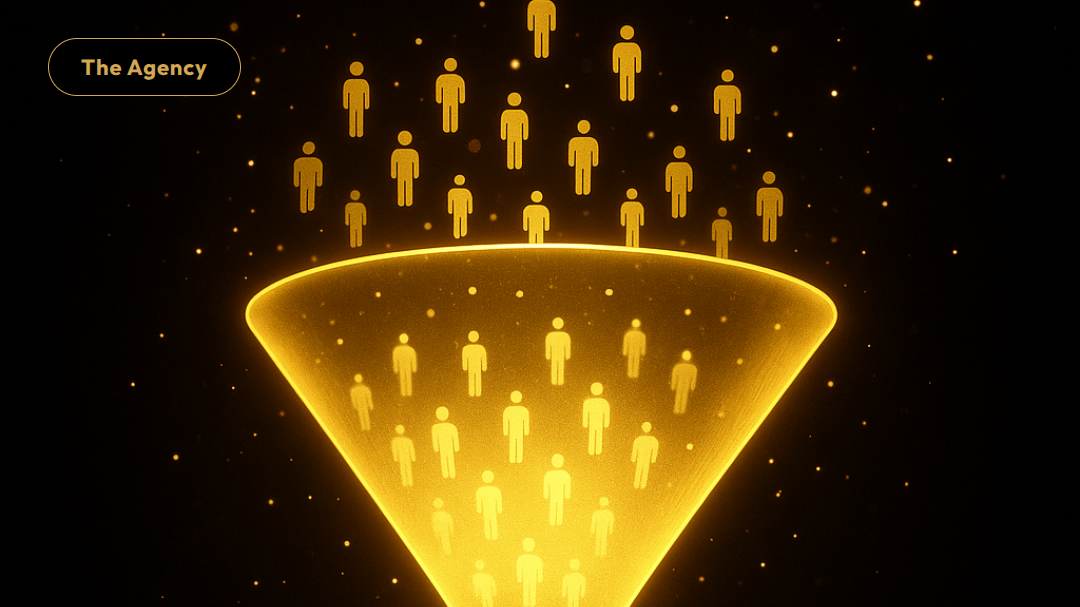
The businesses winning right now are not sending more emails. They are sending fewer emails that are far more relevant and properly researched. That shift happened this quarter.The Agency
Get your business scored out of 10 and your three fastest moves
Get my free Company Report 30 seconds, free. Mapped to your numbers.The shift from grow to relevance
B2B outbound in 2024 was built on volume. Send thousands of emails with name swaps, hope for the best.
In 2026, volume is dead. Relevance is everything.
The change happened because AI made research free. What took 8 minutes of manual work per lead now takes 60 seconds of machine work across a portfolio of prospects. The economics flipped overnight.
Previously, outbound meant buying a list, writing one template, and blasting copies with minimal personalisation. You would insert a first name, maybe the company name, and pray the recipient recognised the effort. Most would not. They would see exactly what it was: a mass email, one of thousands they received that day, with no evidence that anyone had read their website or cared about their business.
In 2026, the equation inverted. If you can research every prospect's recent news, hiring activity, product updates, tech stack, and competitive landscape before sending, your email is no longer cold. It is warm. It reads like someone spent 30 minutes researching their company. In reality, an AI agent spent 60 seconds.
That shift is why outbound is working again.
How outbound changed in June 2026
The old approach was simple but ineffective. Buy 10,000 contacts, write one email, blast it out with name swaps, and watch the response rate collapse. Most prospects deleted the email without reading past the subject line because the effort was invisible.
The new approach inverts this. You identify 200 to 500 high-fit accounts that match your ideal customer profile exactly. You research each one deeply. An AI agent reads their recent news, job postings, tech stack, product releases, and website keywords. You find one or two specific, recent triggers: a funding round, a new VP hire, a product launch, a technology gap you solve for. You write one email per prospect that names that specific trigger and shows you understand their business. You send it within 48 hours while the trigger is fresh.
The response rate climbs. Not because the email is longer or more formatted. Because it is obviously personalised. The prospect knows someone (or something smart) has done research.
The contrast is stark. When a prospect reads "Hi [FirstName], I noticed you work at [Company]," they know it is automated. Delete. When they read "Saw you hired a new VP of Sales last month, congratulations. Here is how that ties into your go-to-market and where most teams like yours stumble," they sit up. They read the rest.
The winning B2B teams are not sending more emails. They are sending far fewer emails that are far more relevant.
What triggers a personalised email now
An AI research agent looking at a company finds multiple potential hooks:
- A new VP or director hire announced on LinkedIn
- A recent funding round, Series A or B, reported by news sites
- A new product feature launched that overlaps with your solution
- A gap in their tech stack: they use Tool A and Tool B but not Tool C, which connects them
- A recent blog post or founder interview where leadership mentions a challenge your solution addresses
- A job posting for a role that suggests they are expanding into a new market or function
Any one of these is a trigger. An email mentioning the specific hire by name, or congratulating the funding, or showing how your solution plugs the integration gap your research found, will get a response. Not because the email is longer. Because it is obviously personalised.
Here is what this looks like in practice. A prospect gets an email that says, "I saw you brought on a new VP of Sales from [Company] last month. That is exactly the hire most teams make when they are preparing for a major go-to-market change. I wanted to share a framework we built for sales teams in your space on how to structure the first 90 days. Happy to give you a quick overview if it lands."
That email takes 60 seconds for an AI agent to research and 3 minutes for a salesperson to write. It reads as though the sender spent 30 minutes researching the prospect's company, its leadership, and its strategy. The prospect will reply not because they are desperate, but because someone has done their homework.
Compare that to a generic email: "Hi [FirstName], I see you work at [Company], which is a great fit for what we do. Would love to chat." That gets deleted. It is obviously a template.
The shift is complete. Personalisation at volume now means research, not name swaps.
Why event-triggered outbound wins
The mechanics are simple but powerful. When a prospect sees evidence of research, three things happen:
First, they believe you are serious. Not every vendor sends an email that mentions a specific recent event at their company. Most mass-market tools cannot do this. So the fact that your email does means you either spent real time or you have a smart system. Either way, you stand out.
Second, they see the email as relevant to right now. If you mention a funding round or a new hire, your email is tied to a real moment in their business. This is not a cold email about "having a solution." It is a timely note about something that matters to them this quarter.
Third, they see it as an opening, not a close. A well-written event-triggered email does not try to sell anything. It offers context or insight related to the trigger. "Noticed you launched this feature. Here is what we saw happen when other teams in your space did something similar, and where most stumble." That is helpful. That is worth a reply.
Generic templates fail on all three counts. The prospect knows it could have been sent to anyone. They do not see how it is relevant to their business right now. And if you do try to sell in the first email, you have wasted their time. They delete it.
The research process: how to build triggers at volume
Building personalised outbound at this level requires discipline, not a complex system. Here is the working model:
Step 1: Define your ideal customer profile. Not "anyone with a pulse." Be specific. Are you selling to SaaS founders with £2M to £10M revenue, bootstrapped, no outside funding yet? Or are you going after funded growth-stage teams with 20 to 100 staff? The specificity matters. Your research and email angles change completely based on this choice.
Step 2: Source accounts that match the profile. Use LinkedIn Sales Navigator, Hunter.io, or built-in AI research agents. Aim for 200 to 500 accounts, not 10,000. You are going deep, not wide.
Step 3: Research each account. This is where AI saves time. An AI agent can pull together company news, recent hires, funding announcements, product updates, tech stack data, and keyword patterns from the company website in under a minute per account. A salesperson cannot do this manually and maintain sanity.
Step 4: Identify the trigger. Look for one or two specific, recent events at each company that create a natural opening for your email. If nothing jumps out, skip the account. Do not force a trigger that feels false.
Step 5: Write the email. Reference the trigger, add one piece of insight or context, and ask for a conversation. Keep it brief. The email is the invitation, not the pitch.
Step 6: Send on time. Send the email within 48 hours of the trigger if possible. If the news is three weeks old, the moment has passed.
This process takes time per account, but the response rate justifies it. One prospect who engages because of real personalisation is worth far more than 100 who delete a template.
The role of AI in outbound today
AI has taken the manual drudgery out of research. Previously, a salesperson might spend 15 to 20 minutes researching a single prospect. Reading recent news, checking LinkedIn, looking at the company website, understanding the tech stack, finding the right contact. Multiply that by 500 accounts, and you have 125 to 167 hours of research before you write a single email.
With an AI research agent, that time compresses to under 5 minutes per account, often less. The AI reads news sources, scrapes LinkedIn, checks company websites, scans job postings, and cross-references tech data. It produces a one-page research brief per prospect that identifies the trigger and gives the salesperson the context needed to write a personalised email fast.
This is not about replacing salespeople. It is about making salespeople far more effective. A salesperson with AI research can now pursue 500 high-fit accounts in the time it previously took to pursue 50. The quality of each email goes up. The time spent goes down. The response rate improves dramatically.
Common mistakes that kill event-triggered outbound
Many teams adopt the research-first model and still fail. Here is why:
Weak triggers. You cannot just say "I saw you are in marketing." Everyone is in marketing. The trigger must be specific and recent. A funding round, a new hire, a product launch, a technology gap. If your trigger could apply to 50% of your list, it is not specific enough.
Generic event emails. Once you have the trigger, do not then write a generic email about your product. "Saw you hired a VP of Sales, great hire, we can help with sales." That is still a pitch. It is not insight. Try instead: "Saw you brought on a new VP from [Company]. That usually signals a go-to-market shift. Have you thought through how you are going to integrate their previous system into your current process? Most teams miss this." Now you are adding value. You are worth a reply.
Timing misses. If the trigger is old (three weeks, a month), the moment has faded. Send the email within 48 hours. If you cannot, do not send. Wait for the next trigger.
Weak follow-ups. The first email rarely closes. Most responses come on the second, third, or fourth email. Space follow-ups 5 to 7 days apart. Each follow-up should reference the previous email and add new context or insight. Do not repeat yourself. Do not try to close on the second email. You are still building a conversation.
Mixing in blast templates. If half your outbound is personalised event emails and half is blast templates, your reputation will suffer. Prospects talk. Word spreads that your team sometimes sends thoughtful personalised emails and sometimes sends junk. Commit to one approach or the other.
Results you should expect
If you build an event-triggered outbound process correctly, here is what changes:
You will have fewer conversations, but they will be better conversations. Your prospects will have read the trigger and will engage on substance from the first reply. You will not waste time qualifying. They will already know why you reached out.
Your sales cycle will compress. Because you are reaching out at the right moment (when they have just hired, just raised, just launched), your message lands when they are most open to exploring solutions. Close rates improve, not because your product is better, but because your timing is better.
Your cost per qualified conversation goes down. You are not buying lists and running high-volume campaigns. You are spending time on research and writing, which grow with an AI agent backing you. One salesperson with AI research can now manage 500 active prospects instead of 50.
Most importantly, your reputation improves. Salespeople know when someone has done real work. When you send an email that names their recent hire and shows you understand their business, they remember that. They reply even if they are not ready to buy, because they see genuine effort. That relationship pays dividends later.
The link to AI-driven strategy
This shift in outbound mirrors a bigger shift across the industry. AI is making strategy and research the competitive advantage, not execution. Any platform can send emails. Any tool can call a prospect. What differentiates teams now is research depth and strategic insight. The teams winning in B2B sales right now are the ones that have built research into their outbound process.
This is exactly what we have built at The Agency. Our approach to outbound combines AI research, strategic insight, and sales execution. We do not believe in high-volume campaigns. We believe in finding the right prospects at the right moment and reaching out with genuine personalisation and insight.
If you are tired of blast templates and want to build an outbound process that actually works, the model in this article is a blueprint. Start with a tight ICP, research deeply, find real triggers, write once per prospect, and follow up consistently. You will see results that justify the effort.
Want to learn how to build this into your sales process? Our team can help you map out the strategy, set up the AI research layer, and train your sales team on the execution. Explore a custom strategy for your business here.
Or read more about building a strong outbound engine in our lead generation resource hub.
Get your business scored out of 10 and your three fastest moves
Get my free Company Report 30 seconds, free. Mapped to your numbers.Frequently asked questions
What changed about B2B outbound in 2026?
AI made research free and fast. What once took hours of manual work per lead now takes seconds of machine work across hundreds. This means personalised emails based on real, recent company events are now the standard, not the exception.
Why are event-triggered emails more effective than generic templates?
When a prospect reads an email mentioning a specific recent event at their company (a funding round, new hire, product launch), they know you have done research. Generic templates with only name and company swaps are obviously automated and get deleted.
How much does an AI research and outbound stack cost?
A complete outbound stack with AI research, event detection, and personalised email generation costs between £150 to £350 per month. The main cost is the salesperson's time spent on follow-up and close, not the tools.
What is the ideal number of prospects to research per quarter?
Quality over quantity. Focus on 200 to 500 high-fit accounts rather than broad lists of 10,000 random leads. Research each one deeply and send one personalised email referencing a specific, recent trigger.
How long should I wait before following up if there is no reply?
Send your first follow-up after 5 to 7 days. Space follow-ups 5 to 7 days apart. Most responses come on the second or third follow-up, not the first email. Consistency matters far more than frequency.
What topics trigger the best response rates in outbound?
Events that matter to the prospect: recent funding, new leadership hires, product launches, or tech stack gaps. Avoid generic observations. If everyone in their industry could say it, it is not specific enough.