Why Businesses Are Replacing Marketing Deliverables With a Working AI Team
The shift from static marketing deliverables to a fully operational AI team is generating more leads, better conversion and real revenue growth for businesses.

The moment our clients stopped paying for reports and started running a team of AI agents, the conversation changed from 'what did we get?' to 'how many leads came in this week?' That is the shift that actually moves revenue.The Agency
Find the gaps leaking the most revenue
Show me my revenue leak Your annual leak in pounds, in 30 seconds. Free.Businesses that have moved away from paying for marketing deliverables and towards running a working AI team are reporting shorter sales cycles, stronger lead pipelines and more predictable revenue growth. The shift is not a subtle evolution in how marketing is purchased. It is a structural change in how marketing actually works, and the businesses making the move in July 2026 are finding that the old model of strategy documents, content calendars and monthly reports simply cannot compete with a team of AI agents that execute around the clock without waiting for a human to act on a recommendation.
The Problem With Deliverables-Based Marketing
For a long time, the standard relationship between a business and its marketing provider was built around deliverables. The agency produced something, handed it over, and the client was expected to implement it. A strategy deck might be brilliant, but if the internal team lacked the time, budget or expertise to act on it, the deck sat in a shared drive and the leads did not come. Reports arrived monthly, sometimes weekly, full of data that described what had already happened rather than changing what would happen next.
This model has a fundamental flaw at its centre: the gap between insight and action. Every day that a business waits to implement a recommendation is a day that a competitor with faster execution is capturing the same audience. In lead generation especially, speed of response is one of the most powerful variables in determining whether a prospect converts or disappears. A deliverables model cannot solve a speed problem because it is, by design, a slow model. It is built around human review, human approval and human implementation at every stage.
The frustration this creates is well documented across businesses of every size. Marketing budgets are spent, deliverables are received, and yet the sales team reports that the pipeline feels thin. The marketing team points to the strategy. The sales team points to the lack of qualified leads. The gap between the two is where revenue is lost, and no number of additional deliverables will close it.
What a Working AI Team Actually Looks Like
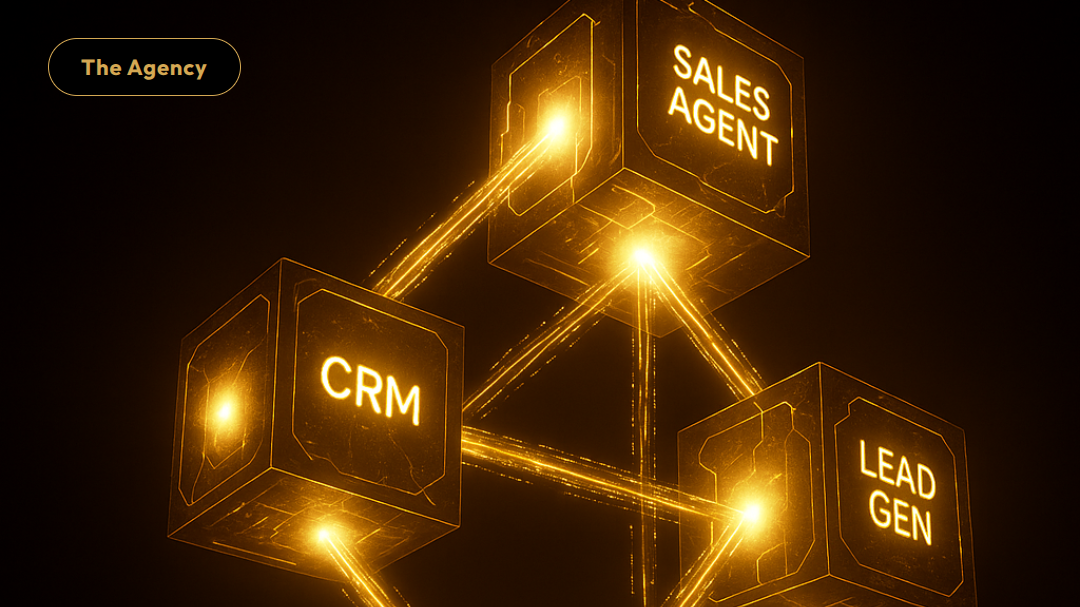
An AI marketing team is not a single tool or a chatbot bolted onto an existing workflow. It is a coordinated set of AI agents, each with a specific function, working together towards a shared commercial outcome. One agent might handle inbound lead qualification, reviewing enquiries as they arrive and scoring them based on fit. Another might run outreach sequences, personalising messages based on prospect behaviour and following up at the optimal moment. A third might monitor campaign performance, adjusting bids, copy or targeting in real time rather than waiting for a human to review a report and make a decision.
The coordination between agents is what makes this model genuinely different from anything that existed even a couple of years ago. Individual AI tools have been available for some time, but they have typically operated in silos. A business might use one tool for content, another for email and another for analytics, with a human required to connect the outputs and make sense of them. A working AI team removes that bottleneck. The agents communicate, share data and act on each other's outputs, creating a system that behaves more like a marketing department than a collection of software subscriptions.
For businesses focused on lead generation, this means the pipeline is being worked continuously. Prospects are being identified, contacted, followed up and moved through the funnel at a pace that a human team simply cannot match, not because the humans lack skill, but because they cannot work without sleep, without weekends or without the cognitive limits that make sustained high-volume outreach unsustainable for people.
Why July 2026 Is the Inflection Point
The shift towards AI teams has been building for some time, but July 2026 represents a meaningful inflection point for several reasons. AI agent technology has matured to the point where the agents can handle genuinely complex, multi-step tasks without constant human oversight. The reliability that was missing in earlier generations of AI tools is now much more consistently present, and businesses that previously experimented with AI marketing and found it inconsistent are returning to find a substantially different landscape.
At the same time, the cost of running an AI marketing team has come down considerably, making the model accessible to businesses that previously could only consider it in theory. A small business that could not justify hiring a full marketing team can now deploy a set of AI agents that collectively do the work of several specialists, at a fraction of the combined cost. This is not about replacing human creativity or strategic thinking. It is about removing the execution bottleneck that prevents good strategy from becoming real revenue.
The businesses leading the way in this shift are those that have recognised a simple truth: the value of marketing is not in the documents it produces, it is in the leads, the sales and the revenue those activities generate. An AI team is the most direct path from marketing spend to commercial outcome currently available.
Lead Generation as the Core Use Case
If there is one area where the move from deliverables to an AI team has the most immediate impact, it is lead generation. This is the function where speed, volume and consistency matter most, and where the limitations of human-operated marketing are most visible. A human team can build a brilliant outreach strategy. They can write compelling copy and identify the right audience. But they cannot follow up with every lead at the optimal moment, personalise every message at volume or monitor every signal that indicates a prospect is ready to move forward.
AI agents can do all of these things simultaneously. They can identify prospects based on behavioural signals, initiate contact, adapt the message based on how the prospect responds and alert a human sales team only when a lead is genuinely qualified and ready for a conversation. This means the sales team spends more time talking to people who are actually likely to buy, and less time working through lists of cold contacts who were never a good fit.
For businesses that have been frustrated by the disconnect between marketing spend and sales results, this is often the change that makes the relationship between the two functions finally make sense. Marketing is no longer producing assets that the sales team may or may not use. It is producing qualified conversations that the sales team can close. If you are considering what this could look like for your business specifically, a custom AI marketing strategy is the most practical place to start.
The Revenue Case for Making the Switch
The commercial argument for moving to an AI team rather than continuing with a deliverables model comes down to the relationship between cost, output and outcome. A deliverables model charges for the production of assets. Whether those assets generate revenue is, in a very real sense, a separate question that the deliverables model does not take responsibility for answering. An AI team model, by contrast, is oriented entirely towards outcomes. The agents are measured on leads generated, prospects qualified and pipeline value created.
This changes the conversation between a business and its marketing provider in a fundamental way. Instead of reviewing what was produced last month, the review is about what revenue was influenced, how many qualified leads entered the pipeline and what the cost per acquisition looks like. These are the conversations that business owners and sales directors actually want to have, and they are the conversations that the deliverables model consistently fails to facilitate.
Businesses that have made the switch also report a secondary benefit that is easy to overlook: clarity. When an AI team is running lead generation, outreach and nurture, there is a clear and traceable line between marketing activity and commercial result. The attribution problem that has plagued marketing for decades, the question of which activity actually caused a sale, becomes much more tractable when the agents doing the work are also recording what they did and what happened next.
Building the Right AI Team for Your Business
Not every AI marketing team is built the same way, and the configuration that works well for an e-commerce business will look quite different from the one that works for a B2B services firm or a professional practice. The starting point for any effective AI team is a clear understanding of the revenue goal: where are the leads supposed to come from, what does a qualified lead look like, and what needs to happen between first contact and closed sale.
From that foundation, the right agents can be selected and configured. Some businesses need heavy investment in inbound qualification because they already have strong traffic but poor conversion. Others need outbound prospecting agents because their audience does not naturally find them through search. Many need both, working together with a shared view of the pipeline so that no prospect is contacted twice with the same message or allowed to go cold because no one followed up at the right moment.
The move from deliverables to a working AI team is not simply a change in vendor or a change in technology. It is a change in what marketing is expected to do and how its success is measured. In July 2026, the businesses growing fastest are the ones that have already made that shift, and the gap between them and those still waiting for the next strategy document is widening every week.
Find the gaps leaking the most revenue
Show me my revenue leak Your annual leak in pounds, in 30 seconds. Free.Frequently asked questions
What is the difference between marketing deliverables and an AI marketing team?
Marketing deliverables are static outputs, such as reports, strategy decks or content calendars, that require human implementation after the fact. An AI marketing team is a set of coordinated AI agents that execute tasks, generate leads, qualify prospects and optimise campaigns continuously. The key difference is that deliverables describe what could happen, while an AI team makes things happen in real time. Businesses that make the switch typically report a much faster path from insight to revenue action.
How does an AI team generate leads compared to a traditional marketing agency?
A traditional agency produces strategies and assets that a business must then activate, often with delays, handoffs and additional costs. An AI team runs lead generation continuously, qualifying inbound interest, following up with prospects and feeding the sales pipeline around the clock. Because the agents operate without downtime, lead response times drop dramatically and fewer opportunities fall through the cracks. This always-on approach tends to produce a more consistent and predictable flow of qualified leads.
Is an AI marketing team suitable for small businesses or only large enterprises?
AI marketing teams are particularly well suited to small and medium businesses because they remove the need to hire multiple specialists across copywriting, paid media, lead generation and CRM management. A small team can effectively punch above its weight by deploying AI agents that handle volume tasks automatically. Larger enterprises benefit from the consistency and speed at which AI agents can process data and act on signals that human teams would miss. The model works at any business size when the strategy is set up correctly from the start.
What kinds of tasks can AI agents handle in a marketing context?
AI agents can handle a wide range of marketing tasks including lead qualification, email outreach sequences, social media publishing, SEO content generation, paid campaign optimisation and CRM updates. They can also monitor competitor activity, flag opportunities in real time and personalise messaging based on prospect behaviour. The most effective AI marketing setups combine agents that specialise in different functions and coordinate their outputs towards a shared revenue goal. This is fundamentally different from using a single AI tool for one task in isolation.
How long does it take to see results from an AI marketing team?
Most businesses begin to see measurable lead generation activity within the first few weeks of deploying a properly configured AI team, rather than waiting months for a strategy document to be implemented. Because AI agents act immediately on the brief they are given, the feedback loop between action and result is much tighter than in traditional marketing models. Early wins often come from lead follow-up and outreach, where speed of response has a direct impact on conversion. Longer-term revenue growth compounds as the agents learn from campaign data and refine their approach.
What should a business look for when moving from a deliverables model to an AI team?
Businesses should look for a provider that builds AI agents around specific revenue goals rather than generic marketing activities. It is important that the AI team integrates directly with existing CRM, sales and communication tools so that leads flow into the right hands without manual intervention. Transparency around what each agent does and how performance is measured is essential, as is ongoing optimisation rather than a set-and-forget approach. A custom strategy session is often the best starting point to map out which agents will have the most immediate impact on pipeline.