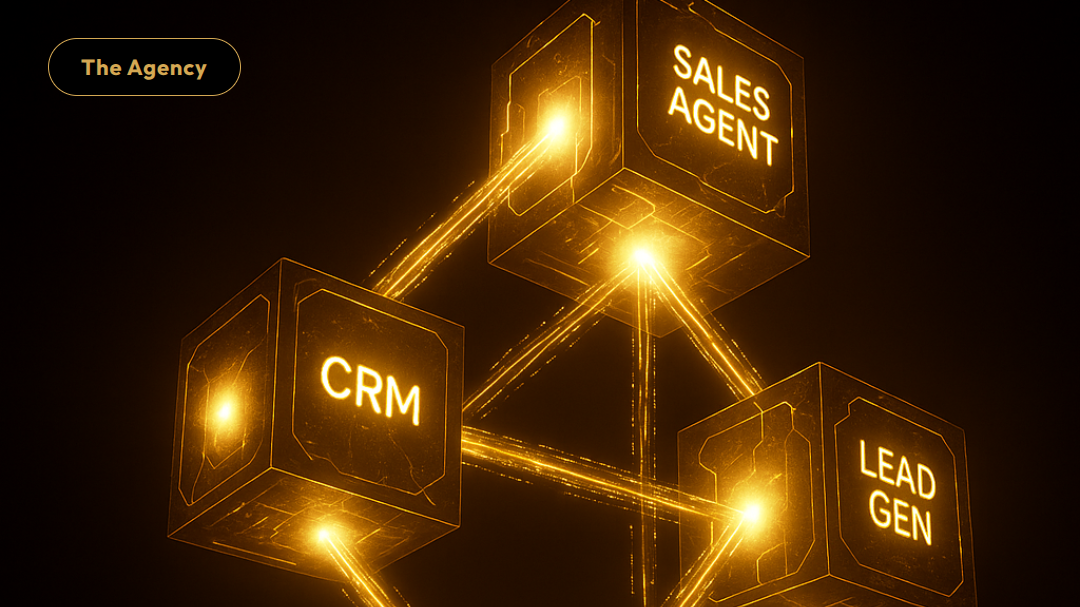
Why Founder-Led Businesses Are the Fastest to Adopt AI Agents (And How It's Winning Them More Leads)
Founder-led businesses are outpacing corporations in AI agent adoption, and the revenue results are making the rest of the market take notice.

When you own the outcome, you move differently. Founders don't wait for a committee to approve the future, they build it themselves, and right now that means AI agents doing the heavy lifting on lead generation and sales.The Agency
Want to see what your business is leaving on the table?
I want a free AI audit Takes 30 seconds. 100% free. No call, no card.Founder-led businesses are winning more leads, closing more sales and growing their revenue faster than their corporate counterparts, and the single biggest reason is their speed of adopting AI agents. While large organisations are still running AI feasibility studies and waiting for procurement approval, founders are already deploying agents that qualify leads overnight, follow up with prospects automatically and book sales calls without lifting a finger. The gap between those who have adopted AI agents and those still debating it is not a technology gap. It is a decision-making gap, and founders close it faster than anyone else.
The Founder Advantage Nobody Is Talking About
There is a structural reason why founder-led businesses are pulling ahead in the AI agent race, and it has nothing to do with technical skill or budget size. It comes down to decision velocity. When a founder identifies a problem in their business, they can research, test and implement a solution within the same week. In a corporation, that same decision travels through department heads, legal, IT security, procurement and a steering committee before a single test is run.
This matters enormously in the current moment because AI agent technology is evolving rapidly. The founders who are acting now are building systems, refining prompts and training agents on their specific buyer journeys while their corporate competitors are still in the approval phase. By the time a large organisation has signed off on a pilot programme, a founder-led business has already iterated through several versions of their AI lead generation system and is operating a mature, revenue-producing process.
Founders also have an emotional relationship with their pipeline that a salaried employee simply cannot replicate. Every unconverted lead represents money coming directly out of the founder's own pocket. That personal financial stake creates a level of urgency and attention to detail that makes founders highly motivated to find and deploy whatever tool closes more deals faster. AI agents are currently the most powerful answer to that problem.
What AI Agents Actually Do for Lead Generation
To understand why founder-led businesses are embracing AI agents so enthusiastically, it helps to be precise about what these agents actually do inside a sales and marketing system. An AI agent is not simply a chatbot or an autoresponder. It is a piece of software that can perceive inputs, reason about them and take autonomous actions without requiring a human to press a button at each step.
In the context of lead generation, an AI agent might monitor a lead form submission, assess the quality of the lead based on the information provided, send a personalised initial response within seconds, follow up across multiple channels over subsequent days, handle common objections with tailored messaging and ultimately book a qualified sales call directly into the founder's calendar. All of this happens without the founder being present or involved at each stage.
For a founder who previously spent hours each week chasing leads, sending follow-up emails manually and trying to remember where each prospect was in the conversation, this is transformative. The agent handles the volume and the consistency while the founder focuses on the conversations that have the highest chance of converting. The pipeline grows without the founder's personal time growing proportionally with it.
AI agents can also handle the outbound side of lead generation, identifying and reaching out to potential prospects, nurturing relationships over time and surfacing the warmest leads for the founder to engage with personally. This combination of inbound qualification and outbound prospecting creates a lead generation engine that runs continuously.
Why Corporate Structures Work Against Rapid AI Adoption
It would be unfair to say that large corporations are unwilling to adopt AI agents. Many of them are genuinely enthusiastic about the technology. The problem is that enthusiasm alone does not translate into deployment when the organisational structure creates friction at every step of the process.
Consider what a mid-sized company must do before deploying an AI agent to handle lead qualification. The marketing team identifies the opportunity and builds a business case. That business case goes to a senior director who needs sign-off from the Chief Marketing Officer. The CMO refers it to IT for a technical assessment. IT raises data security concerns that must be reviewed by the legal team. Legal requests a vendor assessment. The vendor assessment takes several weeks. Meanwhile the original champion of the project has moved on to other priorities and the momentum is lost.
Founders experience none of this. They identify the opportunity, choose a provider, fund the project and begin implementation. The entire process that might take a corporation six to twelve months can take a founder six to twelve days. In a market where early adoption of AI lead generation tools is producing measurable competitive advantages, that speed is not just convenient. It is a genuine business moat.
The corporate friction problem also extends to the configuration phase. AI agents need to be trained on specific business contexts, buyer personas, objection patterns and conversion goals. In a founder-led business, this knowledge lives with the founder, who can brief an implementation team directly and make rapid decisions about refinements. In a large organisation, this knowledge is distributed across multiple departments and gathering it requires meetings, sign-offs and coordination that slow everything down.
The Revenue Results That Are Changing Minds
Skepticism about AI agents tends to dissolve quickly once founders see their pipeline activity change. The most immediate and consistent result that founder-led businesses report after implementing AI agents into their lead generation process is a dramatic improvement in follow-up speed and consistency.
The evidence in the market is qualitative but it is striking. Founders who previously followed up with new leads within a day or two, or sometimes not at all due to time pressure, find that their AI agent responds within seconds of a lead coming in. This speed matters because buyer intent is highest at the moment of initial contact and drops off quickly as time passes. An agent that responds immediately captures interest that a delayed human response would lose.
Beyond speed, the consistency improvement is significant. Human follow-up sequences rely on the founder or a sales team member remembering to send the right message at the right time, which is a reliability problem. An AI agent executes the same sequence flawlessly every time, for every lead, regardless of how busy the business is. This consistency means fewer leads fall through the cracks and more prospects reach the point of a sales conversation.
Founders who have embedded AI agents into their full marketing and sales process, rather than just one part of it, are reporting the most substantial results. When an agent handles inbound qualification, manages follow-up sequences, books calls and hands off warm leads with full context to the founder, the entire revenue process becomes more efficient and more predictable.
If you want to understand exactly how an AI agent system could be built around your specific business model and buyer journey, explore a custom AI lead generation strategy built for your goals.
How Founders Are Using AI Agents Across the Full Buyer Journey
The most sophisticated founder-led businesses are not treating AI agents as a single point solution. They are deploying agents at multiple stages of the buyer journey to create a system where every touchpoint is handled intelligently and consistently.
At the awareness stage, AI agents can monitor social platforms and online communities for signals of buyer intent, identifying prospects who are asking questions or expressing problems that the business solves. At the consideration stage, agents can nurture these prospects with relevant content and personalised messaging that moves them towards a sales conversation. At the decision stage, agents can handle objections, provide social proof and create the conditions that make a prospect ready to speak with a human.
This full-funnel application of AI agents is particularly powerful for founder-led businesses because it replaces what would otherwise require a dedicated marketing and sales team to execute. A founder with an AI agent system in place can compete with the output of a much larger organisation without the corresponding overhead.
The key to making this work is not the technology itself but the strategy behind it. An AI agent that is poorly configured, trained on generic scripts or disconnected from the real buyer journey will underperform. The founders who are seeing the strongest results are those who have invested in building agents that reflect a deep understanding of their specific customer, their objections, their decision-making process and the language they respond to.
What Comes Next for Founder-Led AI Adoption
The current wave of AI agent adoption among founder-led businesses is still in its early stages. The founders who are moving now are building a compounding advantage: their agents get better over time as they process more conversations, encounter more objections and refine their approaches based on real outcomes.
As the technology continues to develop, the capabilities available to founder-led businesses will expand further. Agents that can conduct outbound video outreach, participate in personalised voice conversations, and manage complex multi-step sales processes autonomously are already emerging. Founders who have built the foundation now will be positioned to layer these new capabilities on top of a system that already works.
The businesses that wait, hoping for more certainty or a more convenient moment to begin, are making a competitive choice. In a market where AI agents are actively generating leads and closing sales for early-adopting founders, delay has a measurable cost attached to it. The founders who understand this are not waiting. They are building, iterating and growing, while the rest of the market watches and wonders how they are doing it.
Want to see what your business is leaving on the table?
I want a free AI audit Takes 30 seconds. 100% free. No call, no card.Frequently asked questions
What is an AI agent and how does it help a small business get more leads?
An AI agent is a piece of software that can perform tasks autonomously on your behalf, such as qualifying leads, following up with prospects, or booking sales calls without a human in the loop. For small businesses, this means revenue-generating activity happens around the clock rather than only during working hours. Founder-led businesses in particular find that AI agents replace the manual prospecting work that used to eat into the founder's day. The result is a fuller pipeline with less personal time invested.
Why do founder-led businesses adopt AI faster than large corporations?
Founders have direct control over their tools, budgets and processes, so they can trial and deploy an AI agent in days rather than waiting months for procurement sign-off. There is also a stronger personal incentive: a founder feels every missed lead in their own bank account, which creates urgency that a salaried manager rarely experiences. Large corporations have layers of compliance, IT security reviews and stakeholder alignment that slow every technology decision to a crawl. Founders simply remove those friction points and act.
Are AI agents only useful for tech companies or can any founder use them?
AI agents are being used successfully across service businesses, e-commerce, consultancies, trades, healthcare practices and professional services firms. The common thread is not the industry but the willingness of the business owner to hand repetitive, rule-based tasks over to an automated system. Any business that relies on consistent lead follow-up, appointment booking or customer qualification is a strong candidate. The technology has matured to the point where non-technical founders can deploy agents without writing a single line of code.
How quickly can a founder expect to see results from AI agents in their sales process?
Most founders who implement AI agents into their lead generation or follow-up processes report seeing changes in their pipeline activity within the first few weeks, simply because response times and outreach consistency improve immediately. Meaningful revenue impact depends on deal cycle length and the quality of the agent's setup, so a business with a short sales cycle may see closed revenue within the first month. Businesses with longer consultative sales processes typically notice the first measurable gains in lead volume and booked calls before the downstream revenue follows. The key variable is how well the agent is configured to match the business's specific buyer journey.
What tasks can AI agents handle inside a founder-led business right now?
Today's AI agents can handle inbound lead qualification, outbound prospecting sequences, follow-up messaging across email and SMS, appointment scheduling, CRM data entry, customer onboarding communications and even preliminary objection handling. They can monitor lead sources and trigger personalised responses within seconds of a prospect showing interest. For founder-led businesses, the most immediately valuable use case tends to be the follow-up sequence, because this is the task most founders know they should be doing consistently but rarely have the time to execute properly.
Is it expensive for a small or medium-sized founder-led business to implement AI agents?
The cost of AI agent implementation has dropped considerably as the underlying technology has matured and competition among providers has grown. Many founders find that the investment is offset quickly once the agent starts converting leads that would previously have gone cold due to slow follow-up. The more relevant question is the cost of not adopting: every unconverted lead and every missed follow-up has a revenue value attached to it. Working with a specialist agency to build a custom AI agent strategy tends to deliver a faster return than attempting to piece together tools independently.