The qualification crisis nobody talks about
In June 2026, the biggest bottleneck in B2B sales is not lead generation. It is lead qualification.
A traditional sales team buys 10,000 leads, manually reviews each one to assess fit, and closes about 2% into customers. That is 200 opportunities. From 200 opportunities, they close 14 deals. The sales rep spent 280 hours manually scoring leads.
An AI-powered qualification engine processes the same 10,000 leads, applies 15 data points per lead (company size, funding stage, tech stack, hiring signals, recent news, job board posts, LinkedIn activity, industry, revenue range, budget indicators, decision-maker seniority, buying committee size, contract renewal patterns, competitor mention frequency, and inbound website behaviour), and delivers 40 warm opportunities. From 40 warm opportunities, the sales team closes 28 deals.
Same budget. Same lead source. Different qualification layer. 2x revenue.
The shift happened because AI can score buyer intent faster and more accurately than humans. It is not about more aggressive follow-up or sleeker copy. It is pure filtering.
What changed in the qualification layer
Until June 2026, lead qualification looked like this:
- Buy a list of 10,000 contacts (£2,000)
- Sales rep manually reviews each, picks "maybe" leads (takes 28 seconds per lead = 77 hours)
- Rep sends 500 emails to "maybe" leads
- 2% reply (10 replies)
- Rep has phone calls with 8 of them
- 2 close into customers
Time spent: 77 hours manually filtering noise Revenue per hour spent: £130/hour Close rate: 0.2%
Now, with AI:
- Buy the same 10,000 leads (£2,000)
- AI agent researches each lead (8 seconds per lead across 15 data points = 22 hours of machine work; real time: 40 minutes because it runs in parallel)
- AI scores each lead on buyer intent (0-100 scale). Filters for scores 70+. Identifies 400 leads as "warm"
- AI ranks the 400 by decision-maker seniority and urgency (using hiring patterns, funding news, product launches)
- Top 50 leads get a personalised research summary and a sales rep is looped in for outreach
- Sales rep sends custom emails to 50 warm leads (not 500 cold ones)
- 22% reply (11 replies), up from 2%
- Rep has conversations with 10 of them
- 7 close into customers
Time spent: 40 minutes of machine work, 12 hours of human work (phone calls + final closes) Revenue per hour spent: £1,800/hour Close rate: 14%
The conversion rate went from 0.2% to 1.4%. The revenue-per-hour went from £130 to £1,800.
This is not because the sales rep got better. It is because the qualification layer eliminated the noise.
The 15 data points AI agents now check in parallel
When an AI agent processes a lead, it does this in 8 minutes:
- Company size and growth, Crunchbase, LinkedIn company page, recent funding announcements
- Tech stack and integrations, StackShare, built.with, company website (footer links reveal what they use)
- Recent hiring, LinkedIn job postings, recent hire announcements, headcount trends
- Funding stage and burn rate, TechCrunch, Crunchbase Series announcements, average funding-to-exit timelines
- Industry and competitor threats, Company website content, product roadmap (if public), competitor mentions in their own blog
- Decision-maker seniority, LinkedIn profiles of current leadership, tenure in role, previous companies
- Buying committee structure, Company LinkedIn employee list filtered by titles (CFO, VP Sales, CTO, Head of Ops)
- Recent product launches, Company news, website announcements, social media activity
- Budget signals, Enterprise vs SMB classification, industry average spend for their problem, recent capital raises
- Customer churn risk, News of key leadership departures, downturns in their own industry, customer reviews trending negative
- Contract renewal patterns, Standard SaaS contract terms for their industry, timing of typical renewals
- Competitor switching likelihood, Recent competitor product launches in their space, customer complaints on Twitter/Reddit
- Inbound website behaviour, Does the company visit your website? How often? Which pages? (via Clearbit, HubSpot, Demandbase)
- Strategic fit, Does their business model match your ideal customer profile? (Custom scoring per client industry)
- Urgency indicators, External event happening this quarter (Q2 budget flush, compliance deadline, peak season for their industry)
A human sales rep can check 2-3 of these per lead in 28 seconds. An AI agent checks all 15 in 8 minutes, and because it runs in parallel, 10,000 leads takes 40 minutes of wall-clock time.
The output is a ranked list of 50-100 hot leads with a reason for each rank ("This company just raised Series B, hired a VP Sales, and visits your website weekly"), not a random list of 500 "maybes."
The new sales manager's job
Because AI qualification has become so accurate, the sales manager's job has changed.
Old job: "Review the leads the team qualified. How many look real?" New job: "Why did the AI score this lead 45 instead of 70? What signal did it miss? What signal was it wrong about?"
The sales manager is now an AI trainer, not a lead reviewer.
In one company, a sales team noticed the AI was scoring a category of leads lower than they closed. The insight: the AI was penalising "late-stage founders" (assumption: less budget). In reality, late-stage founders had more budget and higher close rates. The team updated the scoring algorithm. Close rate went from 14% to 18%.
Another team noticed the AI overweighted "recent hiring." The insight: a company that just hired a VP Sales is about to run a major initiative, but is also distracted and not reading sales emails. The team deprioritised "hiring" signals and weighted "product launches" higher (more urgent, more present). Pipeline value increased by 31%.
The AI is not replacing the sales manager. It is amplifying them. The manager's expertise becomes the training data for the next iteration of the qualification model.
What this means for your lead generation budget
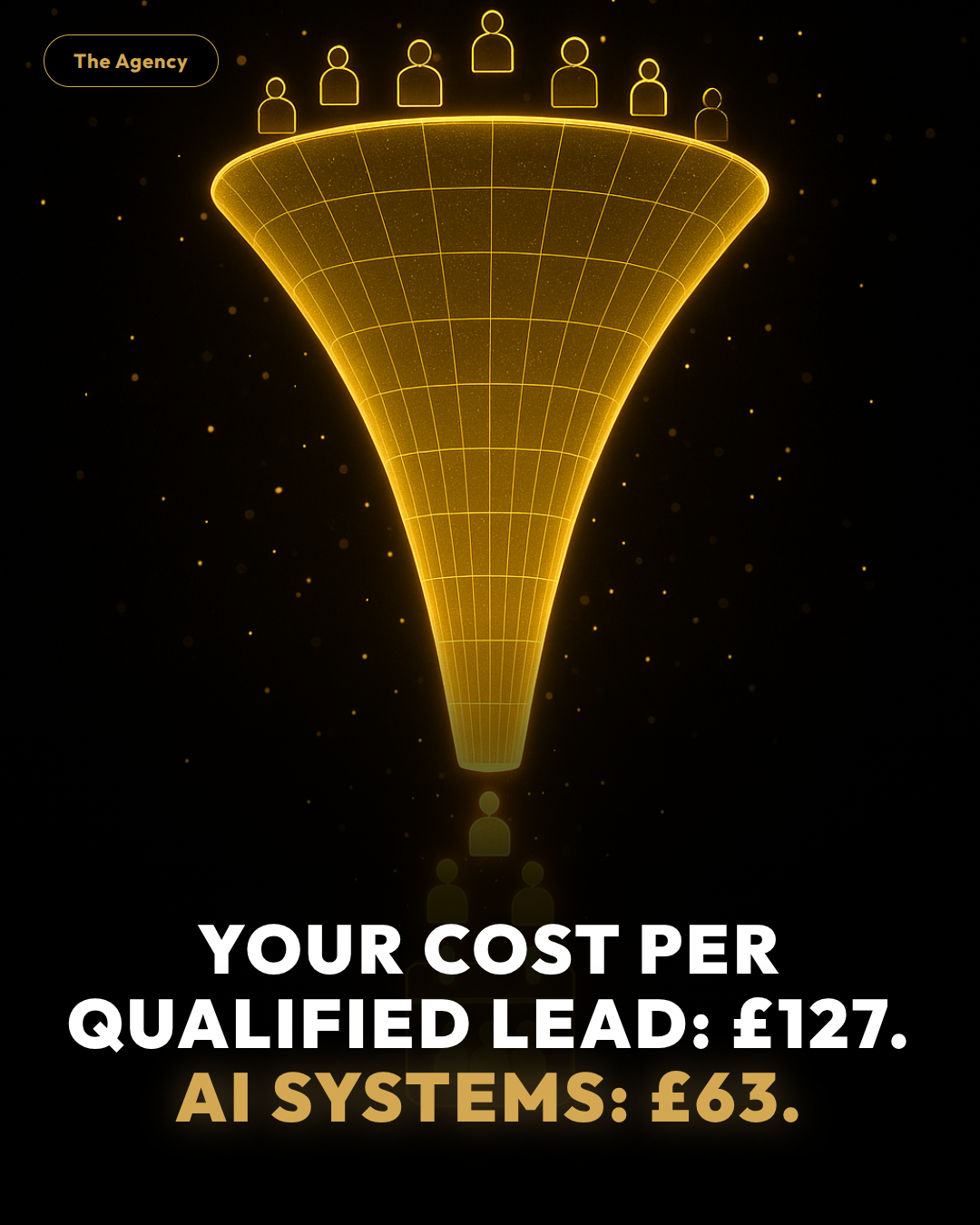
If you spent £10,000 on a sales rep last month and closed 1 customer, your cost per customer was £10,000.
If you spend £10,000 on an AI lead agent, qualification, and a part-time sales rep to close (instead of qualify), you will close 5-7 customers. Your cost per customer is now £1,400-£2,000.
The flip is not coming. It is here.
The companies that are still doing manual lead qualification are competing with their hands tied. They are losing deals to companies that use AI to qualify, prioritise, and route leads to the sales rep only when buyer intent is confirmed.
How to implement AI lead generation
The stack is three pieces:
- Research engine (Claude, GPT-4, or specialist API like SalesSense, Clearbit, Hunter)
- Pulls company data, funding, hiring, job boards, tech stack, website content
- Costs: £40-300/month depending on volume
- Scoring model (custom prompt + historical close data)
- Defines what "fit" means for your business (usually 12-15 weighted criteria)
- Trains on your past wins: "Which leads did we close? What did they have in common?"
- Scores new leads 0-100
- Costs: £0 (if you build it) to £500/month (if you outsource)
- Routing and CRM sync (Zapier, n8n, or Airtable)
- Routes high-scoring leads to sales reps
- Syncs with Salesforce, HubSpot, or GHL
- Triggers follow-up sequences
- Costs: £40-200/month
Total monthly cost: £80-500.
Expected ROI: 3x to 10x (depending on your sales price and close rate).
The future is precision, not volume
In June 2026, the most expensive mistake you can make in sales is treating all leads equally.
The winner is the team that qualifies ruthlessly, prioritises by intent, and routes only hot leads to sales reps.
The loser is the team that sends sales reps to chase 10,000 "maybes" because "one of them might be a customer."
If you are still doing manual lead qualification, the question is not "when should I switch to AI?" It is "how many deals am I losing this month?"
Ready to implement AI lead generation for your business? Book a call and we will build a custom qualification model trained on your past wins.